
- This event has already taken place.
HelloWorld – Arduino – Third Session
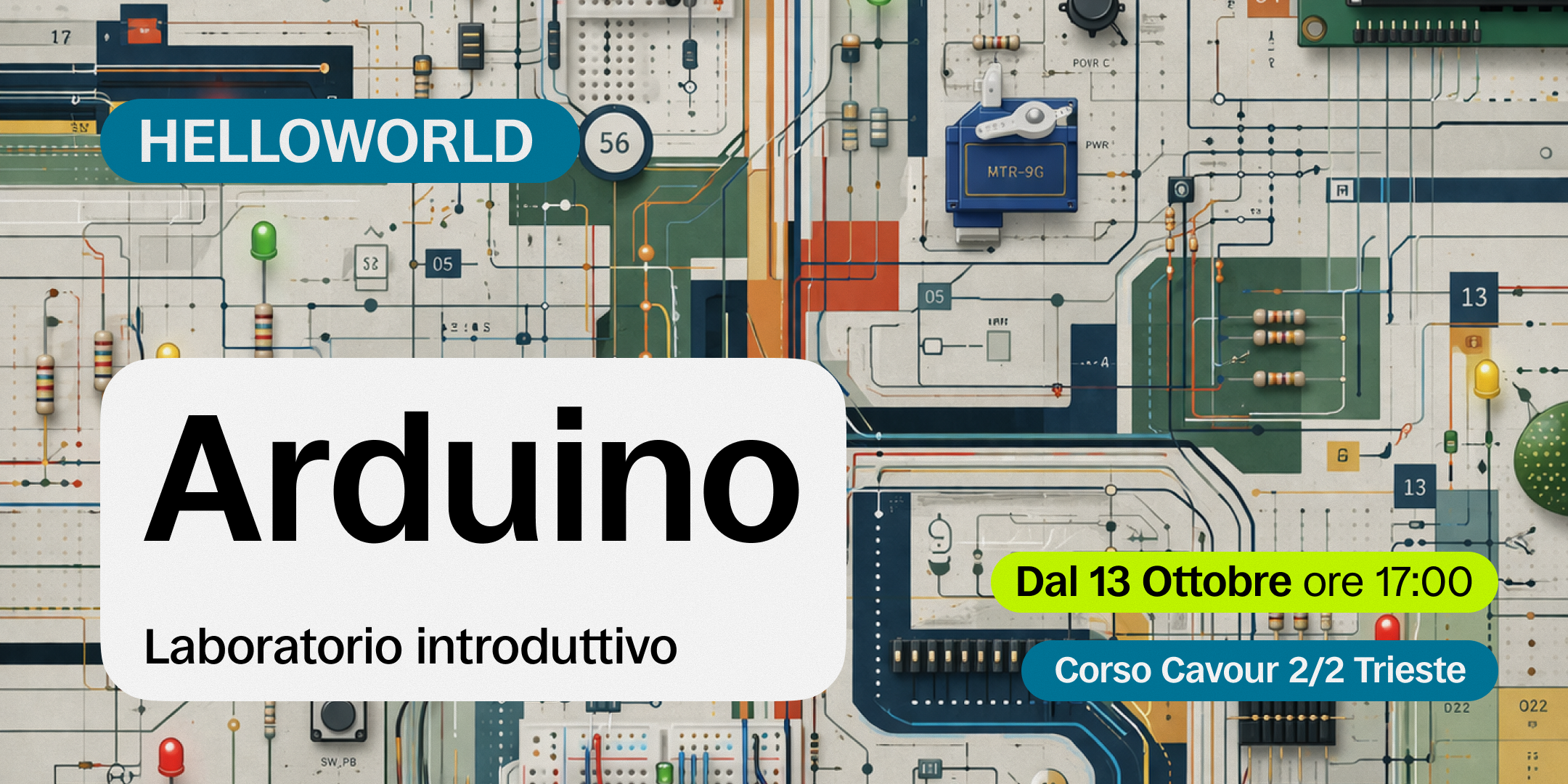
Learn how to bring your projects to life—with code, sensors, and a dash of creativity.
A flashing LED is the first program you write on an Arduino, and it may not seem like much. But then you realize that this flashing is based on the same principle behind a traffic light, a warning sensor, or a rotating radar: from that point on, the code changes, but the idea remains the same.
HelloWorld: Arduino is a series of four sessions designed for absolute beginners. No programming experience is required, and you don’t need to bring anything—the Lab provides the boards, components, and breadboards. Each session alternates between instruction and hands-on work, and ends with something that works.
Tuesday, October 13 · Blinking Bad
What is Arduino, what is it used for, and what can you do with it? We’ll cover the development environment and the structure of a program, then immediately move on to our first result: making the LED built into the board blink. From there, we’ll move on to PWM—the technique used to make a light glow at half brightness instead of full brightness—and set up our first external LED on a breadboard, complete with its connections.
Tuesday, October 20 · Hold My Breadboard
Inputs and outputs: not just turning things on, but reacting. Buttons, LEDs, and the conditions that link them together—if, else, and, or. The project for the evening is a traffic light that alternates between red, yellow, and green: the first, very simple state machine.
Thursday, October 22 ·Why So Serial
Getting Arduino to communicate with the computer. Serial printing, data reading, and real-time graphing. We’ll connect a sensor—either a light or temperature sensor—perform the calculation that converts the signal into a meaningful number, and watch the data move across the screen as something happens on the lab bench.
Thursday, October 29 · Endgame
A more comprehensive project that brings everything together: an ultrasonic radar, either stationary or mounted on a servo that rotates it—we’ll decide together. The last part of the session isn’t about coding: it’s about where to look and what to look for so you can continue on your own, because the journey doesn’t end with the last evening.
PAR SHARESSHARES
Sign up on Eventbrite, and choose whether to attend just one session or the entire series.
Non-members: €30 for a single session, €90 for all four.
Asperastra members: 25 credits for a single session, 75 credits for the full series. Members receive a special code in the newsletter: by entering it on Eventbrite, the ticket price is reduced to zero, so you pay nothing online. However, the course is not free—the credits are deducted at the Lab. Each membership registration or renewal includes 25 credits, which cover the full cost of one session.
The full series can be purchased on the first date. The four-show ticket is available on Tuesday, October 13, and is valid for all four evenings. Single-show tickets remain available for the other dates.
Would you like to become a member? The €30 ticket price for a single session counts as a down payment on the annual membership fee: you pay another €30 at Lab on the day of the class, and the session is included.