Among the projects we’ll be bringing to Maker Faire Trieste, one of the most unique is a chessboard inspired by the city. We like it because it perfectly illustrates a way of working that matters a great deal to us: starting from a local imagination, drawing on a variety of tools—both digital and manual—and ending up with a physical object crafted with care. The idea, on paper, is simple: to transform some recognizable symbols of Trieste into chess pieces. In practice, it’s much less so. A piece must do more than just resemble something. It must stand on its own, have a distinct presence, maintain the correct scale, function within a coherent whole, and remain recognizable even when viewed not as an image but as an object to be held in your hand and placed on a chessboard.
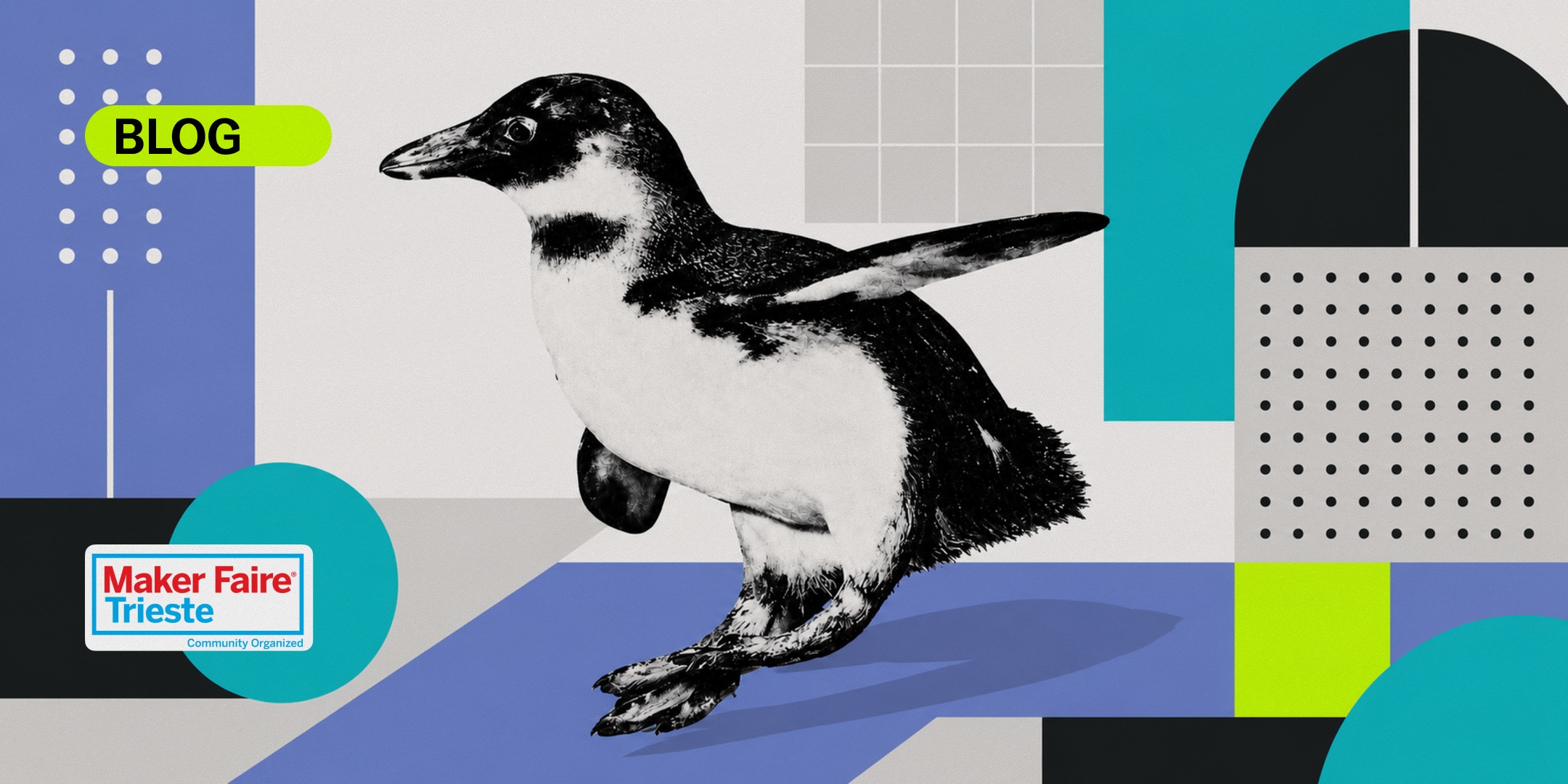
That’s why the project began before the modeling phase, with a process of selection and refinement. We asked ourselves which elements of Trieste had enough impact to become pieces, without slipping into the decorative or the didactic. Miramare Castle was almost inevitable, because it has an instantly recognizable silhouette and a presence that holds up well even as a simplified form. For other pieces, we sought symbols that were less monumental but equally rooted in the city’s collective imagination. Among these, as an emblem, we chose Marco: the penguin who arrived in Trieste from South Africa in 1953, lived for over thirty years at the Marine Aquarium, and remains in the city’s memory as a beloved and distinctive figure.
From there, a phase of visual exploration began. Photos, references, architectural details, and city symbols became the starting point for understanding which directions might work best. During this phase, we also used generative tools available in Lab—not to outsource the project, but to generate more possibilities, test intuitions, and explore useful variations. The prompts were developed with ChatGPT, and the images were generated with Gemini, then selected and moved on to the next stage. Here, AI is neither a shortcut nor the final touch: it is a phase of study, a tool to speed up a process that still requires a keen eye, decision-making, and selection.
The images that seemed to have the most potential were converted into an initial three-dimensional model in .stl format using another AI system. This is a useful step, but not a definitive one. The generated models almost always come with some issues: details lost during printing, surfaces that are too fragile, unconvincing proportions, and elements that work on screen but not in real space. It is at this point that the project ceases to be merely promising and begins to demand precision.
The final touches were made in Blender, where the pieces were corrected, refined, and rebalanced. That’s where you can tell if an intuition truly has substance. If a shape remains recognizable even when scaled down. If a base is stable enough. If the details enhance or detract from the design. If a piece can stand on its own while also fitting into the language of the entire chessboard. It’s a less spectacular process than the initial idea might suggest, but it’s probably what makes the difference between a curious object and a successful project.
The final test, of course, involves 3D printing. The pieces were produced using the Lab’s machines—in this case, a Bambu Lab H2D with a 0.2 mm nozzle—to maintain good precision even on the smallest parts. Printing, however, isn’t just the final technical step. It’s the moment when the project definitively leaves the screen and is tested against reality: weight, proportion, legibility, physical presence. A chess piece must function on the table, not just in a rendering. It must have character, but without losing clarity. It must evoke a symbol of the city, but still behave like a chess piece.
This is the point that interests us most: not the individual technology, but the entire process that connects ideas, research, tools, refinement, and materials.
In the case of the Trieste chessboard, the result brings together the city, the design, and digital fabrication. But for us, the value of the work lies not only in the final object. It lies in the fact that within the Lab, an idea can go through different phases, change form several times, and evolve from an image to a model, from a model to a prototype, and from a prototype to a finished object. It’s a way of working that truly represents us, because it doesn’t treat the lab as a place where a ready-made file is simply executed, but as a space where ideas are put to the test, refined, made more solid, and finally brought to life. The chessboard inspired by Trieste was born from that process.