There are events where you present a project.
And then there are occasions when you try to showcase—even if only for two days—an entire way of working.
For us, Maker Faire will be, above all, this.
On May 9 and 10, we’ll be in Piazza Unità d’Italia with a selection of projects born within Asperastra, along with others developed by our members and the first experiments by the Nexus robotics team. We’re not interested in being there to put on a uniform showcase or present an overly polished image of what we do. We’re much more interested in showcasing a constellation of objects, experiments, prototypes, and paths that truly illustrate what happens when a space like ours is genuinely inhabited.
Different languages have always coexisted within Asperastra.
Robotics, 3D printing, modeling, electronics, design, materials, pop culture, useful objects, less useful but more imaginative objects, prototypes that already work well, and others that are still in the midst of development. It’s a variety we’ve never tried to over-constrain, because that’s precisely where the most interesting part of the work often lies: in the way seemingly distant worlds begin to intersect.
Maker Faire seems to us to be the right setting to bring this diversity out of the Lab.
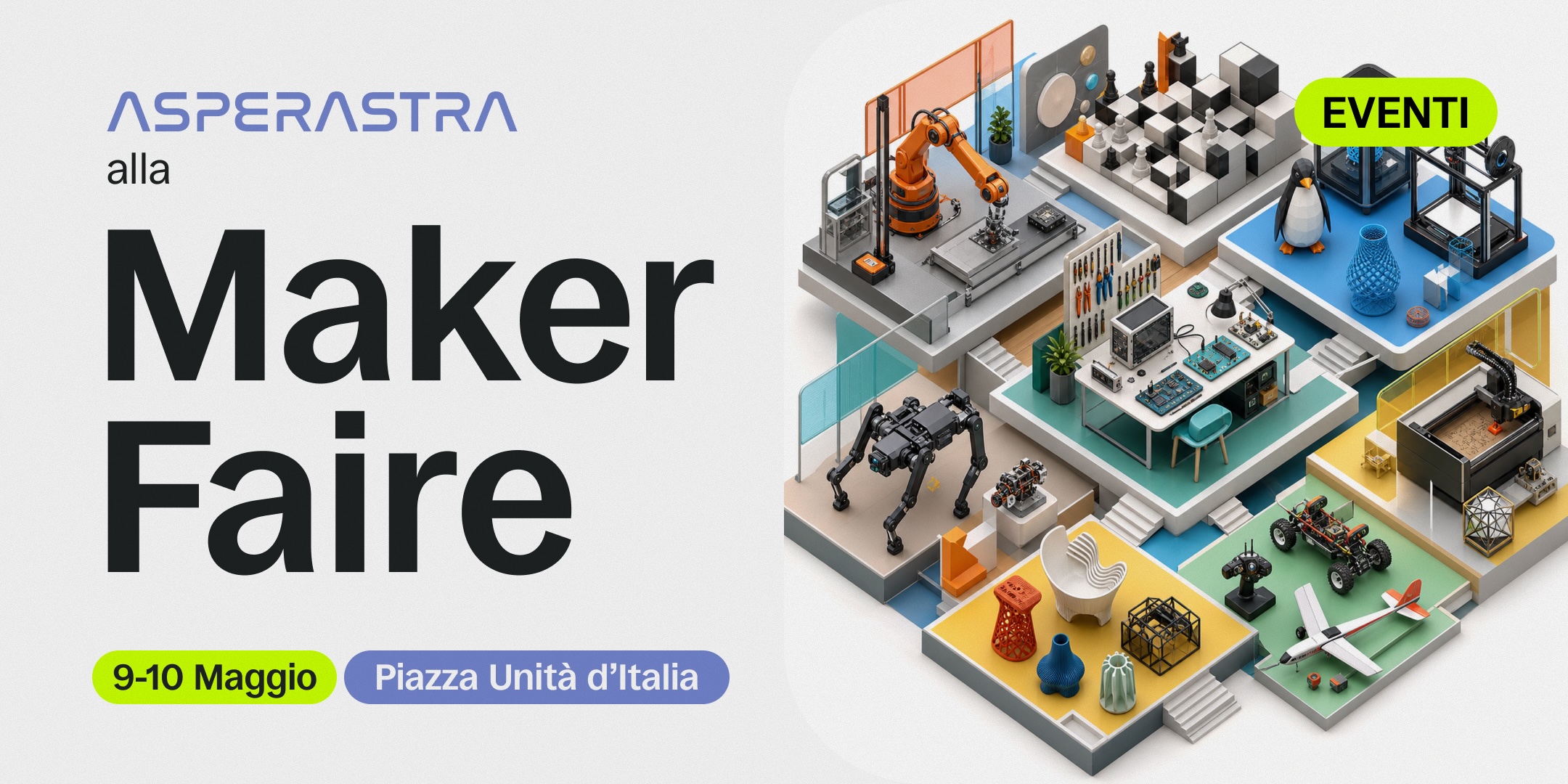
Many of the projects we’ll be showcasing come from our members, and that’s no small detail. In fact, it’s one of the most important aspects of what we do: creating an environment where ideas, skills, and personal experiments can find the tools, time, and space to take shape and become something tangible.
The Maker Faire, then, isn’t just an opportunity to showcase a few objects, but also to highlight some of the work that takes place at the Lab every day. Not only activities organized by Asperastra, but also initiatives that develop within it thanks to the people who inhabit it and bring it to life.
What we’ll bring to the square, therefore, won’t just be a collection of objects to look at.
It will also be a small, visible trace of longer processes: modeling, printing, assembly, testing, errors, revisions, study, rewriting, and adaptations. Some projects will focus more on robotics, others on digital fabrication, and still others on design, materials, or imagination. But all of them, in different ways, deal with the same question: what happens when an idea ceases to be abstract and begins to take shape?
It’s a question that interests us because it’s not just about the final objects.
It also concerns the time, skills, relationships, and contexts that make it possible to get there. That’s why we’re happy to showcase projects that are very different from one another, without forcing them into a single aesthetic or narrative. We prefer to let a certain heterogeneity remain visible. It seems more honest to us—and also closer to what “maker culture” truly means.
Not a perfectly aligned world.
Rather, a space where people experiment, build, modify, learn, and even showcase what’s still in the process of being transformed.
In the coming days, we’ll take a closer look at some of the projects we’ll be bringing with us.
In the meantime, if you’re passing by Maker Faire Trieste on May 9 or 10, come see us.