"HelloWorld" in Asperastra is the format we start with. This time, it took the form of a course dedicated to Arduino, designed to guide those starting from scratch through components, code, and small experiments.
HelloWorld, here at Asperastra, is nothing new. It’s one of the LAB’s oldest formats: the one we’ve used from the very beginning to guide people through a technology, a machine, or a programming language, without making them feel like they’re standing in front of a closed door. It all started with 3D printing. Then the format expanded, changing materials, tools, and approaches. Today, there are HelloWorld sessions dedicated to various technologies, from AI to lasers, from Cricut to Fusion.
The Arduino course came about this way: not as a course that appeared out of nowhere, but as a new variation on a format we know well. It was developed by Martina Anese, a member of Asperastra, an engineering student, and head of the robotics and electronics section at the LAB, who took the HelloWorld framework and adapted it to her own field: that of microcontrollers, circuits, and components that seem tiny but actually open up whole new worlds.

The question we start with, really, is simple: How do you enter this world without getting lost after two minutes?
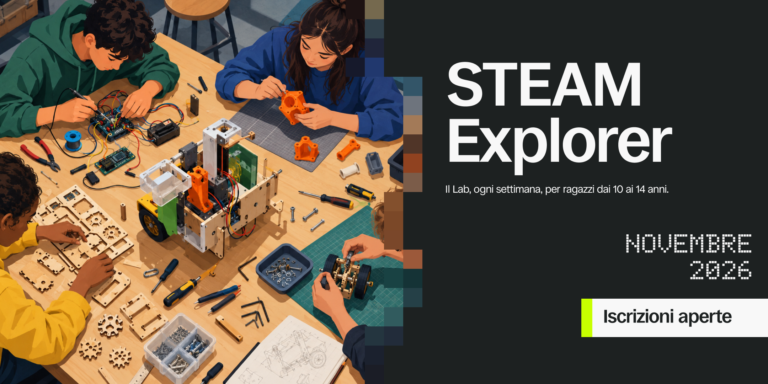
The course spanned four sessions, each with its own pace. We started with the basic commands, the built-in LED, the structure of the code, and the essential steps to build familiarity. Then came basic circuits, breadboards, buttons, resistors, and the first simple logic circuits. Next were motion, analog inputs, and motors. Finally, displays, sensors, and mini-projects—when the basics start to come together and the table fills with things that react, flash, move, and respond.
For those starting from scratch, certain concepts remain abstract until they actually do something right before your eyes. An LED that lights up at the right moment. A servo that turns when it’s supposed to. A small circuit that stops being just a pile of components and starts behaving in a certain way. It’s at that point that technology stops being just a spectacle and starts to make sense.
What’s interesting is that this course isn’t just about Arduino. It shows how ideas take shape within the LAB, when they find the space to come to life. An existing format meets someone with expertise, enthusiasm, and a desire to share them. The community responds. Feedback comes in. And what might have remained a one-off initiative turns into a process worth repeating.
This is also one of the most successful aspects of HelloWorld: each session opens a door. It doesn’t promise that you’ll know everything by the end of four sessions—and thankfully so. It does something more useful: it strips away the veil of mystery, sparks curiosity, and puts the right tools in your hands to really get started.
Following this first event, HelloWorld Arduino is getting ready to return. In the coming days, we’ll open registration for the new edition and post the full schedule of upcoming events here.
For anyone who wants to get started, experiment, and become familiar with electronics and microcontrollers, the time is almost here.